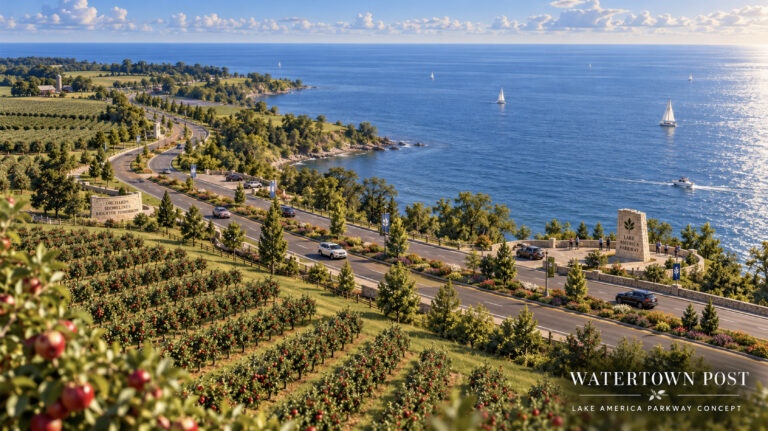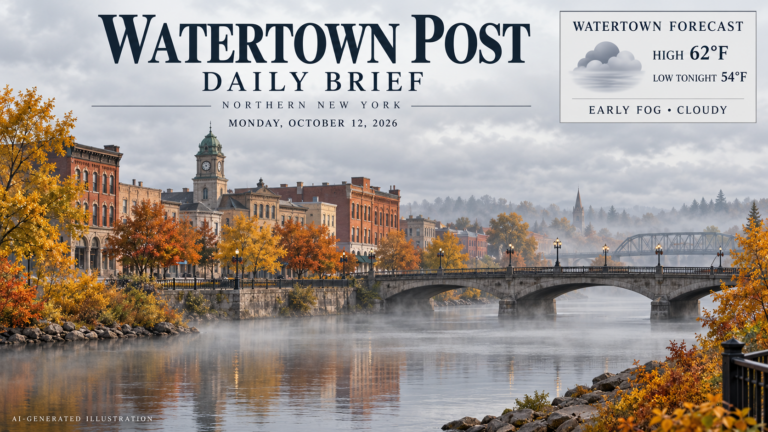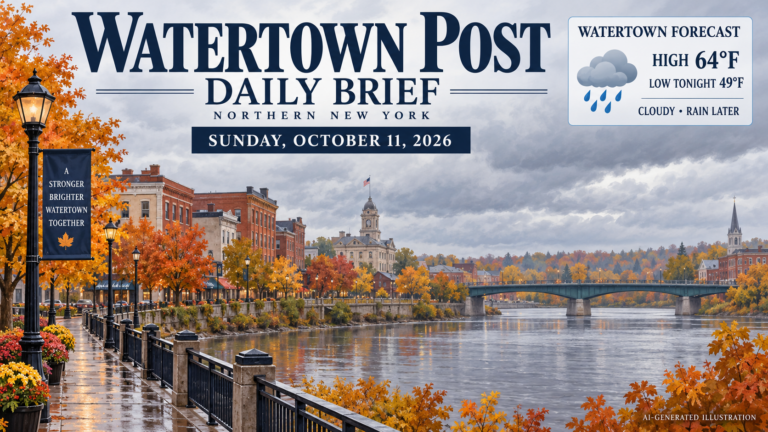
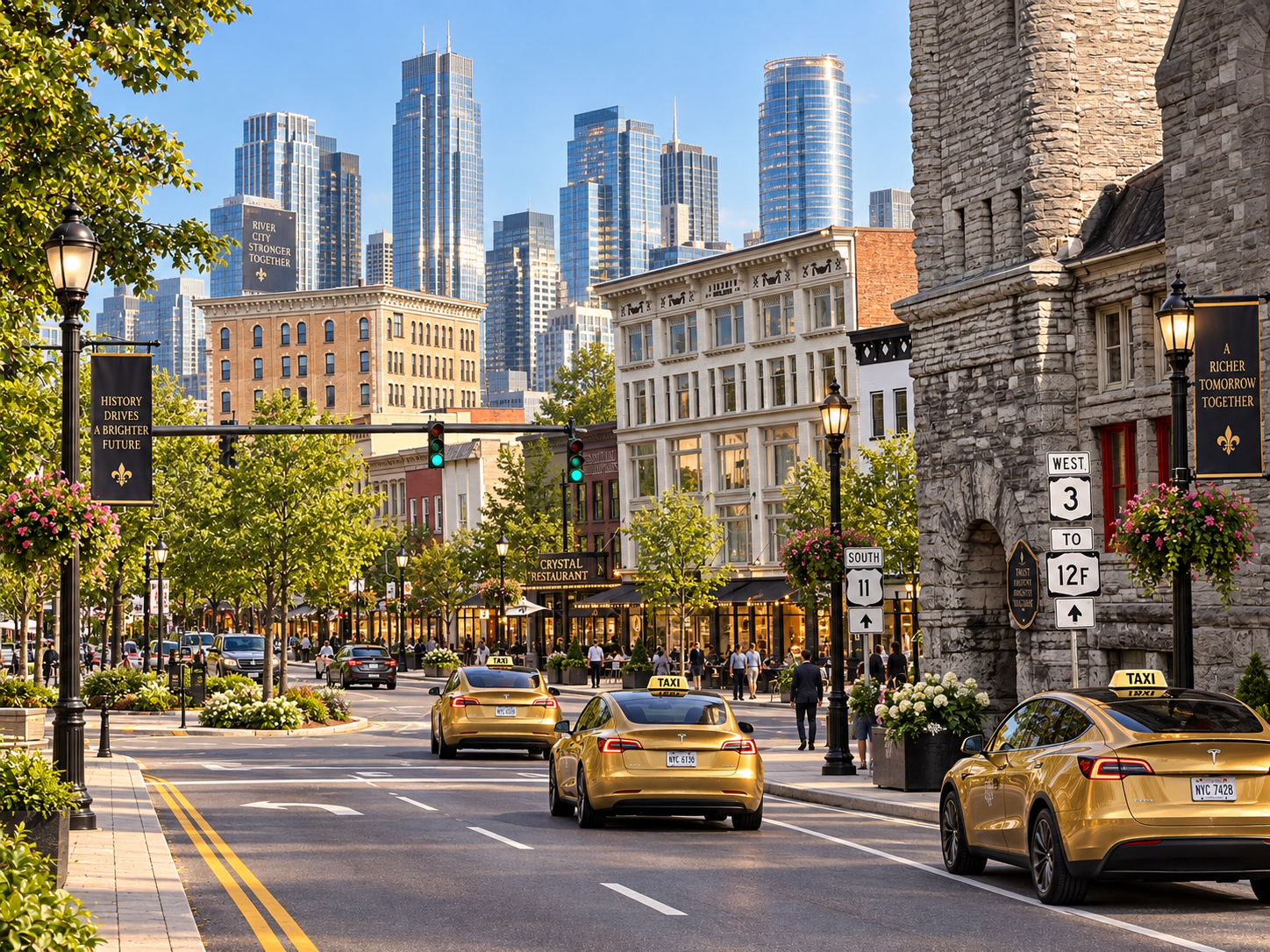
A conceptual look at a revitalized downtown Watertown, preserving its historic architecture while adding modern high-rises, upgraded streetscapes, new development, and gold electric taxis.
The New York Post report should not be treated as an insult to Northern New York. It should be treated as a giant flashing billboard telling Jefferson County that the old municipal model isn’t working — and that a convention center, regional consolidation, aggressive rebranding and perhaps a much bigger North American future deserve serious consideration.
WATERTOWN, N.Y. — Our friends over at the New York Post dropped a little love letter on Northern New York this week.
Le Ray — home to Fort Drum and, by population, the largest town in Jefferson County — landed among the lowest-rated mid-sized communities in the country in AARP’s Livability Index. The Post reported that Le Ray received a score of just 38 out of 100, tying for fourth-worst nationally.
Ouch.
But before everybody in Evans Mills starts barricading the entrances and demanding that Manhattan mind its own business, perhaps we should look at what the numbers are actually telling us.
This isn’t a community without economic activity. Quite the opposite. Le Ray sits beside one of America’s most important Army installations. The problem identified in the report is that local housing costs are unusually high relative to the economic circumstances around them. Average monthly housing costs were reported at $1,489, compared with an $890 comparison median.
The report also highlighted drinking-water violations affecting 32.1 percent of residents and an extraordinarily low civic-engagement score of six.
That doesn’t sound to us like a reason to run Le Ray down.
It sounds like a reason to build something better.
First: Build the Damn Convention Center
Yes, at the mall.
Yes, that mall.
The Salmon Run Mall — the place half of Northern New York has spent the last decade declaring dead, dying or, using the technical economic-development terminology, “shitty.”
Maybe that’s precisely why it makes sense.
The group pursuing the proposed 1000 Islands Event Center has confirmed that the mall is being considered after the previous new-build concept ran into trouble. The idea would be to repurpose existing space rather than start from bare ground.
That is not a boondoggle. It could be adaptive reuse on a regional scale.
The mall already sits beside Interstate 81 and Route 3, has acres of parking, existing utilities and commercial infrastructure. Instead of spending the next 20 years watching another American mall slowly turn into a climate-controlled archaeological site, turn the property into something people have a reason to travel to.
Conventions. Military reunions. Trade shows. Sports tournaments. Agricultural expos. Political conventions. Concerts. Technology conferences. Canadian-American business meetings. Great Lakes and St. Lawrence tourism events.
And if Northern New York’s political and economic geography changes over the coming decades, that facility suddenly becomes even more valuable.
Stop Pretending Watertown Ends at the City Line
Here’s another idea guaranteed to make several town boards reach immediately for the antacids:
Why are we still planning this region as a collection of little governmental islands?
Le Ray had 25,574 residents in the 2020 Census, compared with 24,685 in the City of Watertown. The Town of Watertown had another 5,913. Hounsfield had 3,281.
Put just those four jurisdictions together and you’re looking at roughly 59,500 people.
Suddenly we’re not talking about one little city surrounded by a collection of little towns.
We’re talking about a legitimate regional city anchored by Fort Drum, Interstate 81, the Lake America shoreline, Sackets Harbor, the Thousand Islands gateway and one of the largest military economic engines in the Northeast.
Call it crazy.
Jacksonville, Florida heard the same sort of thing.
Jacksonville Already Showed America How This Can Work
In 1968, Jacksonville and Duval County consolidated their governments.
Jacksonville’s own government describes the move as the merger of the city and county into a unified government. Today Jacksonville has roughly one million residents and markets itself as a major corporate, transportation and logistics center.
Consolidation didn’t magically solve every problem — nothing does — but it gave Jacksonville the ability to think regionally instead of allowing every suburban line on the map to become an economic Berlin Wall.
Even more interesting for Northern New York is what Jacksonville did with its identity.
It began selling itself as the “Bold New City of the South.” The “bold” and the “new” were directly associated with the city’s consolidation and reinvention.
There’s your marketing lesson.
Jacksonville didn’t announce:
“Welcome to Several Adjacent Municipal Taxing Jurisdictions of Northeast Florida.”
They created an identity.
A city.
A brand.
Which Brings Us to America City
The Watertown Post has said it before, and we’ll say it again:
Names matter.
Branding matters.
Marketing matters.
Companies spend billions of dollars understanding this very simple fact, while governments occasionally act as though the name painted on the water tower was handed down to Moses.
A successful name change tells the outside world:
Something happened here.
Jacksonville became the Bold New City.
Northern New York has just been handed an extraordinary national branding opportunity of its own.
So imagine a consolidated regional municipality containing Watertown and potentially willing surrounding towns operating under a new name:
AMERICA CITY, NEW YORK
Laugh.
Go ahead.
People laugh at almost every major branding idea until someone else makes money with it.
From a pure marketing perspective, “America City” is nearly impossible to forget.
America City at Lake America.
Fort Drum at America City.
The 1000 Islands Event Center at America City.
America City International Trade Expo.
America City Convention Center.
America City–Thousand Islands tourism campaigns.
Try getting that kind of national name recognition out of another committee meeting about replacing decorative streetlights.
A name by itself doesn’t fix water lines, housing costs or infrastructure. But a strong brand attached to real investment can change perception, attract attention and create a story investors, tourists and businesses can understand.
That’s what branding is supposed to do.
And Then There Is Canada
Here is where the conversation gets much bigger.
President Donald Trump has repeatedly returned to the idea of Canada becoming part of the United States, and just this Labor Day weekend he again circulated imagery depicting Canada and other North American territory under the American flag. That doesn’t mean Canadian statehood is imminent; Canada remains a sovereign country and its government strongly opposes the idea. But what was once dismissed entirely as internet trolling has unquestionably become part of an ongoing presidential and international political conversation.
So perhaps Northern New York should at least think beyond tomorrow morning.
Because if some form of much deeper North American political or economic unification ever occurred, few American regions would be geographically better positioned to benefit than ours.
Imagine a future with dramatically reduced internal border barriers between New York and Ontario.
Toronto isn’t some distant foreign capital anymore.
Ottawa isn’t “over there.”
Kingston isn’t the place across the water you occasionally visit with a passport.
They become parts of a giant integrated economic corridor running through Toronto–Kingston–Watertown/Fort Drum–Syracuse and onward into the American Northeast.
Goods move faster.
Workers move more easily.
Companies gain access to a larger seamless market.
Tourism changes completely.
The Thousand Islands stop functioning primarily as an international boundary and increasingly function as the middle of an economic region.
And where would you want a convention and events center serving that corridor?
Maybe right beside Interstate 81 in Northern New York.
Funny how that works.
Northern New York Has Been Thinking Too Small
This is the bigger point.
Our problem isn’t Le Ray.
Our problem isn’t Watertown.
Our problem isn’t Hounsfield.
And our problem certainly isn’t an old shopping mall.
Our problem is the persistent belief that Northern New York should plan its future according to boundaries drawn for communities that existed 150 or 200 years ago.
Fort Drum changed this region.
Interstate 81 changed this region.
The Thousand Islands tourism economy changed this region.
Global trade changed this region.
And whatever ultimately happens between the United States and Canada could change it again.
Jacksonville eventually figured out that the city and the suburbs were parts of the same organism.
Maybe Jefferson County should start having that conversation.
Not necessarily identical consolidation. Not necessarily every town. And certainly not without voters having their say.
But begin asking the question:
What would we design if we were building Northern New York today instead of inheriting it from 19th-century maps?
Maybe it looks like a larger regional city.
Maybe it includes Le Ray.
Maybe it includes the Town of Watertown.
Maybe it reaches toward Hounsfield and Sackets Harbor.
Maybe there’s a major convention center sitting inside a completely reinvented Salmon Run complex.
And maybe the sign beside Interstate 81 someday says:
WELCOME TO AMERICA CITY
Gateway to Lake America, Fort Drum and the Thousand Islands
The New York Post says one of our largest communities is among America’s least livable.
Fine.
Let’s build one of America’s most interesting instead.
And as for the bigger North American map?
We wouldn’t bet the mall on it tomorrow morning.
But these days, you might want to keep the architectural drawings handy.
About the Author