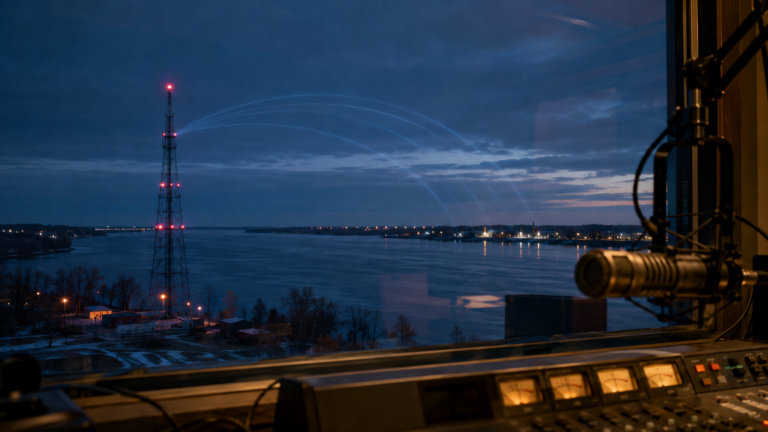

For roughly a month, Watertown’s AM 1240 WATN has also been heard on 92.7 FM WQTK in Ogdensburg. Suddenly, two familiar Watertown talk shows had access to a stronger FM presence in St. Lawrence County, along the Canadian border and potentially across portions of eastern Ontario.
It should have been an enormous opportunity.
Here was a chance to transform small-market local radio into something bigger: a genuinely regional, cross-border conversation reaching two counties, two countries and communities tied together by commerce, tourism, family, history and one very large lake with an increasingly entertaining identity crisis.
But after listening since the simulcast began, one thing became painfully obvious: hardly anybody new called.
Very few voices emerged from Ogdensburg. Almost none came from Canada. The same signal traveled farther, but the conversation remained largely where it had always been—inside Watertown’s municipal boundaries, circling the same personalities, the same City Hall arguments and the same handful of dependable callers.
The transmitter crossed the border. The content never left Public Square.
That is not necessarily the fault of the audience. You cannot simply place Watertown programming on an Ogdensburg frequency and expect Canadians to begin dialing the studio out of patriotic curiosity. A larger signal requires a larger editorial vision.
Where were the discussions about cross-border trade, tariffs, tourism, shipping, agriculture and the Thousand Islands? Where were the Canadian guests, Ogdensburg business owners, St. Lawrence County officials and callers from Kingston, Brockville, Prescott and Ottawa?
And, during one of the most fascinating periods in modern American-Canadian relations, where was the show built specifically around the border?
Northern New York sits in a broadcasting position most American radio stations would envy. WQTK’s FM signal serves a region where two countries meet, where American and Canadian news overlap daily and where one good controversy can travel from Watertown to Toronto before the afternoon coffee gets cold.
Used properly, that platform could attract listeners far beyond the traditional local audience. It could generate clips, podcasts and national syndication opportunities. It could offer advertisers something more valuable than another hour devoted to Watertown’s recycling schedule.
Instead, the FM expansion appears to have been treated primarily as a larger pipe carrying the same bucket of water.
Then came Friday.
Jeff Graham told listeners Thursday that he would not be on Friday and reportedly seemed unsure why. Glenn Curry was also absent. During the noon hour, listeners encountered stretches of dead air—broadcast not only on WATN, but repeated through the Ogdensburg FM signal.
Perhaps it was merely a holiday-weekend scheduling problem. Perhaps it involved technical work as WQTK attempts to restore its independent programming. There is presently no evidence proving either host has been dismissed.
But the silence offered an unintended metaphor.
Community Broadcasters had two frequencies, two markets and access to an international audience—and, for at least part of Friday, nothing to say on either one.
Local radio is not dying because people suddenly stopped caring about local voices. It is struggling because too many owners keep shrinking the ambition of the product while expecting the audience to grow.
WATN and WQTK briefly possessed the ingredients for something rare: a live North Country border network capable of connecting Watertown, Ogdensburg and Canada. The opportunity was sitting there, humming through the transmitter.
All it needed was programming that traveled as far as the signal did.
About the Author