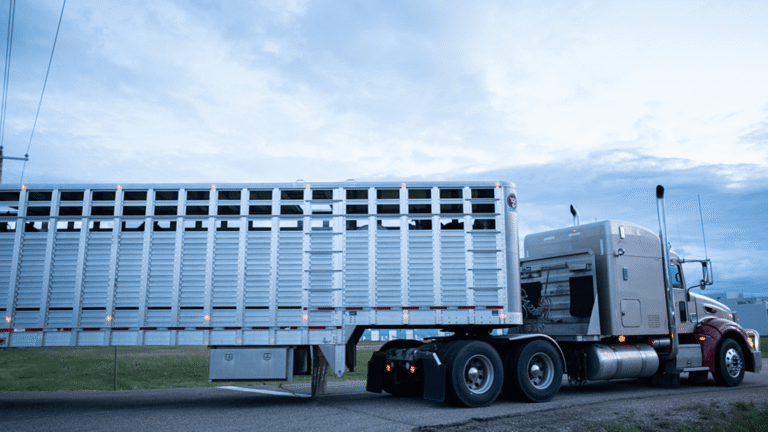

Animal transport truck arrives at an airport in Edmonton. Carrying horses that will be moved into crates and onto a plane destined for slaughter. Photo credit: Jo-Anne McArthur / HSI Canada / We Animals
The Watertown Post | Golden Age Opinion
DEKALB, N.Y. — Canada gave us maple syrup, hockey and the enduring impression that everybody up there is exceptionally nice.
Apparently, the horses should read the fine print.
New York State Police stopped a truck on U.S. Route 11 in DeKalb early September 2 carrying horses investigators say were headed to Canada for slaughter. The animals were removed from the driver’s custody and placed under protection. For once, flashing lights in the rearview mirror meant somebody’s day was about to get considerably better. Incident reporting
According to accounts of the State Police investigation, the shipment was bound for a Quebec slaughterhouse, with the horses intended for human consumption. Authorities identified the driver as Robert M. Seitz of Pennsylvania. He was charged under New York’s horse-slaughter law and issued an appearance ticket for DeKalb Town Court. The charge is an allegation, not a conviction. Investigation details
Here in the North Country, we generally expect a horse trailer to be headed to a farm, a fair or somewhere a little girl can spend every dollar her parents have on riding lessons.
A dinner reservation is considerably further down the list.
And yes, Canada permits horse slaughter. This isn’t an internet rumor somebody found between a UFO video and an argument about lake names. The Canadian Food Inspection Agency openly explains that horse meat is eaten in Canada and other countries, and that licensed Canadian facilities export it to Japan and elsewhere. The agency provides slaughter inspection services for horses as it does for other food animals. Canadian Food Inspection Agency
Nothing says “we’ve normalized this” quite like a government webpage explaining the paperwork.
Americans should understand our own situation, too. The last U.S. slaughterhouses processing horses for human consumption closed in 2007. But that did not end the shipment of American horses to foreign slaughterhouses. The ASPCA reports approximately 25,000 American horses were transported to slaughter facilities in Canada and Mexico in 2025. U.S. slaughterhouse history, ASPCA’s current figures
Closing the kitchen while continuing to deliver the ingredients is a peculiar definition of solving the problem.
New York has gone further. Agriculture and Markets Law §385 prohibits slaughtering horses for human or animal consumption and also prohibits specified transactions and transportation undertaken with that intent. That distinction matters: the state’s protection reaches beyond the slaughterhouse door. New York’s law
For a state capable of making practically everything complicated, “don’t haul horses through here to become dinner” is refreshingly understandable.
Now, before anyone turns this into an immigration argument: there is no evidence in the reporting reviewed that recent arrivals in Canada had anything to do with this shipment. Horse-meat consumption and the international trade are longstanding. The documented issue is an established industry, the people supplying it and the governments allowing it.
And plenty of Canadians object. The BC SPCA campaigns against live exports for slaughter and reports that a May 2026 national poll found 81 percent of Canadians disagreed with how Canada is exporting horses today. That poll concerns export practices, but it makes one thing clear: opposition doesn’t stop at the border. BC SPCA
Our Canadian friends fighting this business deserve support. Their government deserves questions.
From this newspaper’s Golden Age perspective, American greatness ought to include some gratitude toward the animals that helped build the country. Horses carried soldiers, pulled equipment, worked farms and hauled communities forward long before horsepower became something advertised during football games.
We can debate the broader ethics of livestock all afternoon. We can also decide that these animals deserve stronger protection from a commercial slaughter pipeline.
Credit to the troopers and the organizations that helped bring this shipment to their attention. Compassion became something tangible on a North Country highway: an intervention that changed where those horses were going.
Welcome to northern New York. Bring your passport, enjoy the scenery—and leave Secretariat off the menu.
About the Author