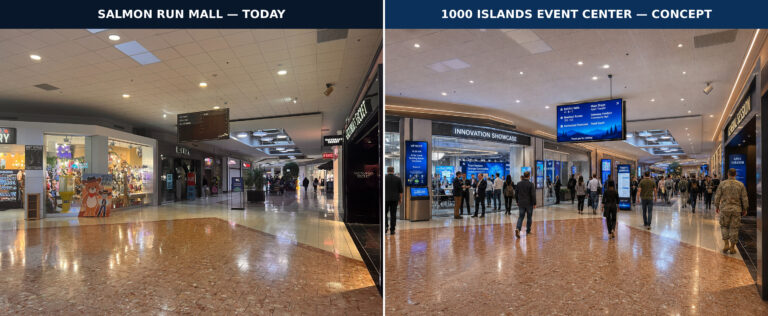

Converting an existing 673,000-square-foot regional mall into a flexible convention and event destination could generate year-round business, protect a major commercial property and finally give Northern New York room to expand.
WATERTOWN, N.Y. — The latest argument making the rounds is that Town of Watertown taxpayers should “beware” of the proposed Thousand Islands Event Center because it could become another government boondoggle.
The Watertown Post disagrees.
Taxpayers should always examine the numbers. They should demand transparency, private investment, professional management and ironclad protections against unlimited public losses. That is responsible government.
But calling the Salmon Run concept a boondoggle before a mall-specific feasibility study, acquisition price or renovation plan has even been completed is not fiscal conservatism. It is simply declaring defeat before Northern New York has bothered to compete.
This project should be viewed for what it could become: a major economic investment in the future expansion of the Town of Watertown, the City of Watertown, Jefferson County and the entire Thousand Islands–North Country region.
Who Is Behind the Project?
The organization guiding the effort is the Thousand Islands Local Development Corporation, chaired by Town of Watertown Supervisor Joel Bartlett.
According to its official mission, the LDC was established to promote responsible economic growth throughout the Thousand Islands and North Country through recreation, sports, entertainment venues and other regional facilities. It has served as the project sponsor for the proposed multi-purpose event center. Read the LDC’s project overview.
That distinction matters. This is intended to be a regional economic-development project—not simply another municipal building where somebody cuts a ribbon, serves sheet cake and then wonders what to do with it on Monday morning.
Salmon Run Is Not an Empty Field and a PowerPoint Presentation
Salmon Run Mall already contains approximately 673,242 square feet of gross leasable space on 85 acres. The property is adjacent to Interstate 81 and sits along a heavily traveled section of Route 3.
The commercial listing reports approximately 18,190 vehicles per day on Route 3 and 20,400 vehicles per day on nearby Interstate 81. It also describes the mall as 86.2 percent occupied, meaning a redevelopment would have to protect and complement its successful stores rather than bulldoze what is already working. See the JLL property details.
The existing complex already has:
- Highway access
- Large parking areas
- Climate-controlled interior corridors
- Major utility connections
- Restaurants and retail services
- A multiplex movie theater
- Multiple large anchor spaces
- Nearby hotels
- Room for additional development
Those are expensive components that do not have to be invented from scratch.
Nobody should pretend that converting a mall will be cheap. Roofs, heating systems, loading access, structural requirements, fire protection and exhibition utilities must all be professionally evaluated. But examining an existing 673,000-square-foot building is considerably more sensible than automatically assuming the only respectable convention center is one constructed in an empty field at enormous cost.
The building is already there. The highway is already there. The parking is already there. The hotels are already there.
Occasionally, economic development begins by noticing the gigantic building directly in front of us.
Jefferson County Already Has a $348 Million Visitor Economy
This is not a theoretical tourism market.
Visitors spent approximately $348.3 million at Jefferson County businesses in 2024, according to Tourism Economics data commissioned by Empire State Development and I LOVE NEW YORK.
That spending included:
- $105.8 million on food and beverages
- $64.4 million on lodging
- $47.4 million on retail goods and services
- $19.2 million on recreation and entertainment
- $11.4 million on local transportation
- $100 million connected to vacation properties and second homes
Visitor activity also generated an estimated $23.5 million in county tax revenue and supported $156.3 million in local employment income. See the Jefferson County tourism figures.
A convention center would not create Northern New York tourism from nothing. It would give an already substantial visitor economy somewhere to gather during the months when the boats are covered, the docks are empty and the thermometer is apparently trying to leave the state.
That year-round component may be the project’s greatest economic advantage.
The Earlier Projections Were Significant
Under the previous stand-alone event-center proposal, the LDC projected:
- At least 250 new events annually
- More than 305,000 new visitors per year
- More than 93,500 overnight visitors
- Between $25 million and $28 million in annual visitor spending
- Approximately $5.64 million in additional annual hotel revenue
- Approximately 50 full-time on-site jobs
- Another 28 full-time-equivalent jobs elsewhere in the regional economy
- Approximately $11.4 million in additional sales-tax revenue during the first five years
- Approximately $846,000 in additional hotel-tax revenue during that period
Those projections were prepared for the earlier facility—not for a Salmon Run conversion—and must now be recalculated. They are not guaranteed results, and nobody should present them as such.
But they provide a measurable benchmark. A new independent feasibility study can determine how much of that demand could realistically be captured at the mall and at what cost.
That is how adults evaluate an investment: update the figures, test the assumptions and structure the deal accordingly. Screaming “boondoggle” from a Facebook comment section is not yet recognized as an accounting method.
The Money Would Travel Far Beyond the Town Line
The economic benefit would not stop at the Salmon Run property boundary.
Convention visitors would spend money at hotels, restaurants, bars, gas stations, rental-car companies, stores, entertainment venues and local attractions. Event organizers would hire caterers, electricians, security personnel, cleaners, audiovisual technicians, decorators, printers, transportation providers and temporary workers.
The Town of Watertown would host the facility, but the City of Watertown would benefit from hotel stays, restaurant traffic and downtown visits. Sackets Harbor, Henderson Harbor, Cape Vincent, Clayton and Alexandria Bay would gain additional tourists and extended stays.
Economic activity does not pull over at a municipal boundary and ask whether it is still allowed to spend money.
The property’s 85 acres also create room for future private expansion: additional lodging, restaurants, entertainment, recreation, transportation services and complementary commercial development. The objective is not merely to fill yesterday’s mall. It is to create enough demand to build tomorrow’s regional business district around it.
Fort Drum Creates an Entire Convention Market of Its Own
Fort Drum is the largest single-site employer in Northern New York. Its official fiscal-year 2025 report recorded approximately $2.2 billion in direct economic impact, including 13,320 assigned soldiers, 22,736 military family members and 3,698 civilians and contractors working on the installation. Read Fort Drum’s FY2025 Economic Impact Statement.
A flexible regional convention center could pursue military and civilian events involving:
- Defense technology
- Unmanned systems and robotics
- Cybersecurity
- Emergency management
- Military logistics
- Veterans’ organizations
- Workforce recruitment
- Public safety
- Healthcare
- Education and technical training
- Government contracting
- Military-family services
It could also host agricultural expos, home shows, hunting and fishing conventions, outdoor-recreation events, snow-industry conferences, youth sports, concerts, comedy, esports, business meetings, religious gatherings, graduation ceremonies and regional trade shows.
The point is flexibility.
If the people managing the facility remain imaginative and open-minded, this would not be a building waiting all year for one basketball tournament. It could function as Northern New York’s public gathering place, exhibition hall, technology showcase, entertainment venue and regional business marketplace.
Worldwide, business events generated an estimated $1.3 trillion in direct spending during 2025, averaging approximately $785 per participant, according to research produced for the Events Industry Council by Oxford Economics. The research also found that conventions generate business partnerships, customer leads, workforce development and knowledge sharing beyond the spending occurring during the event itself. See the 2026 business-events study.
Northern New York deserves a piece of that economy.
Then Came the Lake America Marketing Gift
President Donald Trump’s August 27 executive order officially renamed Lake Ontario as Lake America for federal purposes.
Whatever anyone thinks of the name, the marketing opportunity is real.
Executive Order 14422 specifically identifies Oswego and Sackets Harbor while describing the lake’s importance to American trade, military logistics, shipbuilding and the War of 1812. They are the only two New York communities specifically named in the order’s historical account. Read Executive Order 14422.
Sackets Harbor is only a short drive from Salmon Run Mall.
That gives the proposed center something convention facilities spend fortunes trying to create: a nationally recognizable story.
The facility could be marketed as the gateway to Lake America, the Thousand Islands, Fort Drum and historic Sackets Harbor. Visitors could attend a convention, tour the battlefield, dine on the waterfront, visit the Thousand Islands and stay an additional night.
The executive order does not pay for the project, of course. Unfortunately, branding still refuses to pour concrete.
But it hands the region a valuable promotional identity at precisely the moment Salmon Run is being considered for reinvention. Failing to use that opportunity would be economic malpractice.
Canadian Tourism Is Down—But Canada Has Not Disappeared
Yes, Canadian travel to the United States fell sharply during 2025 and remains below earlier levels.
But Statistics Canada reported that Canadian residents still returned from 2.3 million trips to the United States in June 2026. That was 24.6 percent below June 2024, but it was also a 5 percent increase from June 2025 and the third consecutive month of year-over-year growth. See the Statistics Canada report.
In other words, Canadian tourism is down. It is not dead.
Canadians did not vanish into the northern mist. Spend ten minutes at an Arsenal Street traffic light and count the Ontario license plates. God bless them—they are still here.
Household budgets, currency differences and political tensions may change how frequently Canadians travel and how much they spend. That is why the center should never depend exclusively on Canadian customers.
Its foundation should be domestic conventions, Fort Drum-related activity, youth sports, regional trade shows, entertainment and the American drive market. Canadian attendance should be welcomed as additional business—not treated as the only business plan.
Protect the Taxpayers and Build the Future
Supporting the concept does not mean approving a blank check.
Before public money is committed, taxpayers should receive:
- An independent market and feasibility study
- A complete inspection of the mall’s structure and mechanical systems
- A realistic acquisition and renovation budget
- Full disclosure of public and private financing
- Protection against unlimited municipal operating subsidies
- A plan preserving the property-tax base, including a PILOT agreement if necessary
- A phased construction plan protecting existing tenants
- An experienced private operator with measurable performance requirements
- Annual public financial reports
- Milestone-based release of any public funding
- Clear attendance, hotel-night, employment and tax-revenue targets
Those safeguards separate a serious investment from an actual boondoggle.
If the numbers ultimately fail, the project should not proceed. But if private partners assume meaningful risk, the existing building can be converted affordably, the tax base is protected and independent research confirms demand, rejecting it because growth sounds frightening would be shortsighted.
Northern New York has spent decades watching larger communities build the facilities, attract the events, fill the hotels and collect the revenue.
At some point, we must decide whether our economic strategy is to manage decline gracefully or create something capable of expansion.
The Watertown Post chooses expansion.
A successfully operated Thousand Islands Event Center at Salmon Run Mall would create jobs, protect a major commercial property, strengthen local businesses, extend the tourism season, support Fort Drum, promote Sackets Harbor and give the Lake America region a year-round destination.
That is not a boondoggle.
That is called building an economy.
About the Author