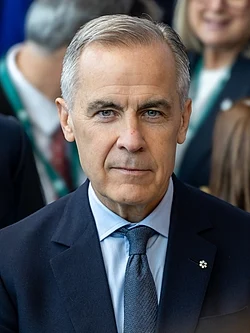
Prime Minister Mark Carney’s criticism of American memes has intensified questions about censorship, political speech and the growing divide between Canadian and American values.
-Sackets Harbor NY By Hans Wilder
Canadian Prime Minister Mark Carney recently told Americans to “stop doing memes, stop throwing shade and stop trying to be tough.”
We heard him clearly.
Carney may insist that his remarks were directed only at members of the Trump administration. That distinction is not convincing. American officials communicate through the same public platforms used by millions of ordinary citizens. Political memes are created, circulated and transformed by the public. An attack on that culture is therefore an attack on how Americans participate in political life.
The immediate American response was predictable: We made more memes.
That reaction reflects something fundamental about the United States. Americans do not need permission from foreign leaders—or their own government—to ridicule politicians, criticize public policy or express unpopular opinions. Our political humor can be harsh, irreverent and occasionally offensive. That is not a defect in American democracy. It is evidence that citizens remain free to challenge authority.
Carney’s remarks matter because they reveal a widening ideological divide. On one side is the American freedom-first tradition, which begins with individual liberty and distrust of concentrated government power. On the other is a collectivist political model that increasingly treats speech as something authorities must supervise, regulate or suppress for the supposed protection of society.
When officials begin treating words, jokes and images as threats, censorship is rarely far behind.
Canada has already expanded the federal government’s role in its information environment. The Online News Act established a government-supervised bargaining system for large digital platforms and news organizations. Supporters call that a defense of Canadian journalism. Critics reasonably view it as another mechanism through which Ottawa can influence how information is financed and distributed.
Then there is the Canadian Broadcasting Corporation. The CBC receives public funding while reporting on the politicians responsible for that funding. Its defenders point to formal protections for editorial independence. But no amount of paperwork can completely erase the conflict created when a media organization relies upon government appropriations for its continued operation.
That does not mean every CBC journalist takes orders from the prime minister. It means Canadians should question any arrangement in which the government finances a powerful national broadcaster and then presents privately owned American media as uniquely manipulative.
Carney’s comments are especially revealing because Canada has much larger problems than American memes.
For years, Canadian immigration policy allowed population growth to outrun the country’s ability to provide housing, healthcare and infrastructure. Ottawa has finally begun lowering its targets, but only after the consequences became impossible to ignore. Canada admitted approximately 393,500 permanent residents in 2025. The government has reduced its target for new temporary residents from 673,650 in 2025 to 385,000 in 2026. Immigration, Refugees and Citizenship Canada
Those reductions amount to an admission that the previous approach was unsustainable. A government does not impose dramatic corrections when everything has been proceeding responsibly.
Canada’s economy is also struggling. Real GDP grew only 1.7 percent in 2025—the weakest annual performance since 2020—and contracted by 0.2 percent in the fourth quarter. The Bank of Canada reported that economic activity was roughly flat in early 2026, while unemployment generally remained between 6.5 and 7 percent. Statistics Canada, Bank of Canada
Canadians do not need officials to tell them whether the economy is healthy. They experience it through housing costs, grocery bills, taxes, limited opportunity and declining confidence in their country’s future.
Canada’s inability to defend its enormous territory is equally troubling. Russia continues to expand its military presence in the Arctic, while China pursues influence through economic pressure, technology, espionage and strategic investment. Canada spent decades falling short of NATO’s defense benchmark while relying upon the United States to provide much of North America’s real deterrence.
Ottawa says defense spending reached 2 percent of GDP in fiscal year 2025–26 and points to new investments in NORAD and Arctic surveillance. That improvement is welcome, but reaching the minimum after years of neglect does not instantly produce a capable military. Personnel, equipment, infrastructure and operational readiness cannot be rebuilt through an accounting announcement. Canadian Department of National Defence
These failures strengthen the case for greater North American unification.
The people of Canada and the United States already share a continent, an integrated economy, extensive family connections and a common defense perimeter. Our energy systems, manufacturing industries and supply chains cross the border every day. Russian aircraft and Chinese strategic ambitions do not respect the line between Alaska and the Canadian Arctic. Economic decline in Canada does not stop when it reaches the St. Lawrence River.
North American unification should not mean hostility toward the Canadian people. It should mean recognizing that Canadians and Americans are safer, freer and more prosperous when artificial political divisions give way to deeper economic, military and cultural integration—pursued peacefully and with the consent of the people involved.
Ottawa’s governing establishment will resist that idea because unification threatens its authority. It would force Canadians to compare their institutions directly with American constitutional protections, economic opportunities and freedom of expression. It would also expose how often anti-American rhetoric has been used to distract from failures at home.
Carney wants Americans to stop making memes and start behaving according to his definition of seriousness.
But freedom is serious. Speech is serious. National defense is serious. Economic decline is serious. An immigration system that overwhelms housing and public services is serious.
Mocking powerful officials remains one of the oldest and healthiest democratic traditions. Americans will not surrender it because Canada’s prime minister dislikes the message.
We will keep speaking.
We will keep making memes.
And we will keep making the case that the future of this continent belongs to a freer, stronger and more unified North America.
About the Author